I rarely find myself in Seattle's Madison Park. I don't really know why. It's nearby, it's accessible, and it's got lots of character. But I'll be honest. The only reason I ended up at Nishino was because it has the highest rating on Yelp for sushi in Seattle.
Nishino is one of those places that's as casual or as formal as you want to make it. Service will make you feel like you're at an exclusive, fine dining establishment, while the welcoming, warm lighting will make you feel like you're over at your friend's house. Table seating is smartly elevated, is not too crowded, and overlooks the expected open sushi bar. Overall, the restaurant felt casual, comfortable, and inviting, three adjectives I would probably use to describe Tatsu Nishino's omakase.
The meal started off with a five-item plate. The first was a Spot Prawn and Tomato with Wasabi Sauce. The spot prawn was super fresh and the wasabi sauce brought a light heat to the fresh tomato. It was a really bright way to start the meal and wake up the palate.
The Sockeye Salmon with Kelp balanced out the lightness of the previous bite with more fat and a generously seasoned sheet of kelp. The lemon added a needed acidity to make the transition from the spot prawn more gradual.
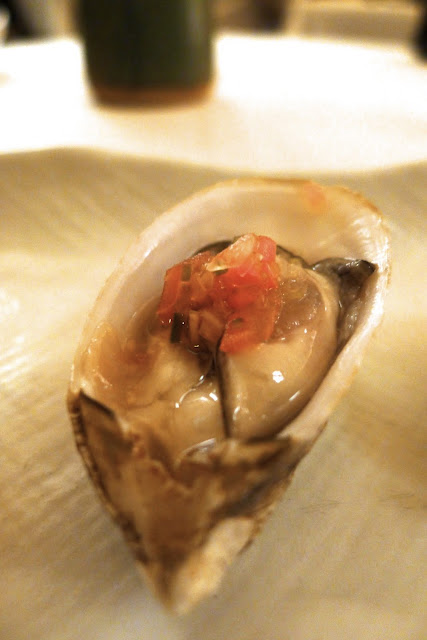
The third bite brought things back to a strictly lighter tone. The Shigoku Half Shell with Ginger Salsa was unbelievably fresh and the restrained amount of ginger salsa brought a light kick to the nose. The contrast of the ginger against the oyster really helped to bring out the more subtle tones in the oyster. This was my second favorite of the five bites.
The fourth bite was Yellowtail with a Cucumber Wrap and Miso Sauce. Yellowtail is my favorite type of sashimi, and this did not disappoint. The miso sauce moved the bite away from being very light, while the cucumber helped to make sure things didn't get too heavy. This was my favorite of the five.
The last bite of the first course was a Sesame-Crusted Albacore on a Cucumber Slice. Like the previous bite, this one had a nice mixture of light and heavy, but leaned more towards heavy. The albacore was topped with a delicious and restrained mix of ponzu, radish, red pepper, and green onion. This last bite made sure that you felt like the first course was satisfying and not too scant.
The second course was what Nishino calls a New Style Sashimi. Basically, it's arugula wrapped in whitefish seared with extra virgin olive oil, sesame oil, and ginger soy sauce, topped with some lemon juice and scallions. While this was probably my least favorite course of the night, I appreciated the flavors that came through in this dish. I just wish the flavor of the fish and the arugula came through more. The dish seemed a bit over-seasoned with the various oils and sauces. I still ate every last bite though.

Next up was the Foie Gras and Seared Tuna with Shiitake Mushroom and Red Wine Soy Reduction. This dish was incredible. I'm not the hugest fan of foie mainly because I feel like a lot of places slap on too huge a portion of foie as if to say, "Look! We have foie gras!" The play on a surf and turf here was clever and perfectly restrained. While I could have used a little bit less of the red wine soy reduction, the lightly seared tuna brought a needed lightness to the small piece of filling foie. The shiitake mushroom brought a great level of umami to round out the dish. Really amazing. Of the few preparations of foie gras I've had, this just might be my favorite. This one is on their permanent menu, so grab this if you get the chance.

The fourth course was the Albacore Tuna Sashimi Salad on Mixed Greens with House Dressing. This course was a great way to lighten up the meal after the previous course. Though there was nothing mind-blowing about this course, I really appreciated the simplicity and predictability of this course. This dish brought things back to the comforting and recognizable standbys of Japanese-American sushi restaurants. The salad did come with some awesome lotus root chips, however, that brought some texture to the plain mixed greens and generous cut of albacore sashimi.

The next course was a Mushroom Dashi Soup with Mizuna, Enoki, Black Cod, and Tofu. Every part of this soup was beautiful. The broth itself was extremely aromatic and filled my nose with comfort and a light smell of mushrooms every time I went in for another spoonful. The enoki mushrooms were slightly crisp, the mizuna added a hint of bitterness and pepper, and the perfectly-cooked black cod and tofu both melted in my mouth. This course was a perfect way to bring some warmth to the meal after the salad.

The sixth course was String Bean and King Crab Tempura with a Spicy Lemon Garlic Sauce. The string bean tempura were pretty standard, but the king crab tempura was out of this world. The crab was perfectly cooked, with the crunchy exterior giving way to the juicy and flavorful crab. The spicy lemon garlic was also a great way to bring some more complementary flavors to the dish in lieu of your standard tempura sauce. I also loved the lightness of the tempura batter. The course was filling, but still very light for a plate of tempura.
It was that good.
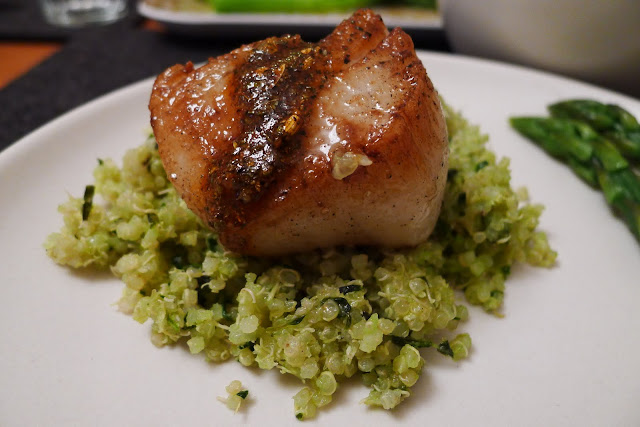
Course number seven featured another well-known Nishino standard, Curried Seared Halibut Cheek with Sautéed Mushroom and Swiss Chard and a Cilantro Aioli. The halibut itself wasn't my favorite piece of cooked fish, and while the curry seasoning was interesting at first, the flavor got a little stale with certain dried out pieces of the fish. The mushrooms and chard, however, were great, and they went really well with the two mounds of addictive cilantro aioli. I'm 100% confident that I was just unlucky and got one of very few overcooked fish that gets to the customers.
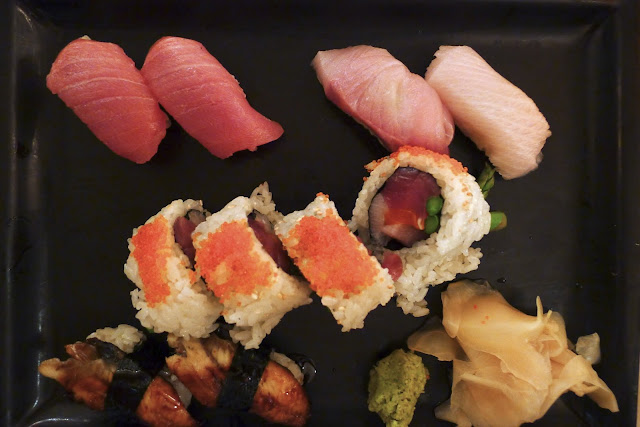
The last savory course was an obligatory Chef's Selection of sushi. While the Unagi Nigiri were typical and sweet, the rest of the selection was worthwhile.
The House Special Roll with Tuna, Yellowtail, Salmon, Whitefish and Asparagus was what I'd consider an inverted rainbow roll with asparagus instead of avocado. While I still think I prefer avocado over asparagus in anything related to sushi, the freshness and irresistibility of the fish made this roll easy to sink. The fish in this roll got me really excited to try the last two nigiri.
The Chuu Toro is exactly what I wanted it to be: super fatty and super fresh. I actually ate this as a sashimi without the rice, and the second the tuna laid itself down on my tongue, the corners of my mouth moved up my face. I don't think I've ever had a piece of chuu toro that I've hated.
Last, but not least, was a huge piece of my favorite sashimi: Hamachi. Hamachi has always struck a chord with my taste buds. Something about its deep, rich, somewhat oily yet refreshing flavor, along with its effortless ability to melt on your tongue, makes this variety of sashimi irresistible. This generous slab did not disappoint, and like all the other fish in this omakase, the hamachi tasted absurdly fresh. I had this one without the sushi rice, too.

The omakase rounded itself out with a Green Tea Tiramisu. Something about this dessert made me smile. While the rest of the omakase was so delicately and minimally presented, the dessert looked like something I would get at my aunt's house: a plate with a delicious cake surrounded by mountains upon mountains of fruit. This dessert was in some was a testament to the warm, familial, inviting nature of Nishino. While the light, moist cake was delicious and full of matcha, the freshness of the fruits shone more. I love it when restaurants end your meal with fresh fruit because it always makes you feel better about yourself.
Nishino's omakase reminds the diner that an omakase is not about flashiness or absolute uniqueness. It's about the diner placing his trust in what the chef wants to share, and in Tatsu Nishino's case, he shares his love for keeping things casual, comfortable, and inviting. While his appreciation for basics, simplicity, and restraint shines through with nearly every course, Nishino will occasionally invite you to participate in small twists, contemporary preparations, and new flavors.
Nishino
3130 E Madison Street
Suite 106
Seattle, WA 98112
(206) 322-5800
GET: Omakase; Foie Gras and Seared Tuna with Shiitake Mushroom and Red Wine Soy Reduction; Sashimi.